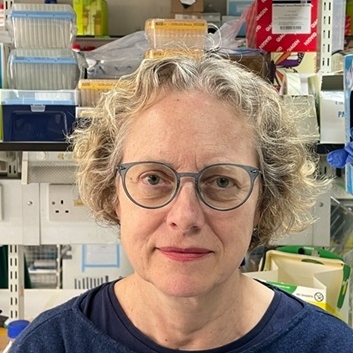
Professor Lizzy Fisher, a former PhD student and later Programme Leader at MRC Harwell, has been elected a Fellow of the Royal Society.
The Royal Society is the oldest scientific academy in continuous existence. Each year the current membership elects up to 109 new Fellows who have made substantial contributions to the improvement of natural knowledge, including mathematics, engineering science, and medical science. Lizzy is one of more than 90 outstanding researchers from across the world elected to Fellowship this year.
After an undergraduate degree in Oxford, Lizzy did her PhD in mouse molecular genetics at Imperial College London and MRC Harwell, supervised by Steve Brown and Mary Lyon. This was a technically demanding project involving the dissection of individual chromosomes and cloning DNA fragments into plasmids, in nanolitre volumes. She completed the PhD in 1986 and in 1987 started postdoctoral work with David Page at the Whitehead Institute, MIT, where she identified a novel gene involved in the aneuploidy, Turner syndrome.
After a few years, she returned to Imperial to start her own group, studying the effects of aneuploidy. She also started a hugely fruitful collaboration with Jo Peters at MRC Harwell (after a chance telephone call with Jo’s lab member Simon Ball) in the early 1990s, and was involved with the big project headed by Pat Nolan, with Steve Brown, Sohaila Rastan of Glaxo Smithkline and Jo Martin of QMUL, that generated new mutants for biomedical research, and SHIRPA, a new standardised phenotyping protocol. In 2001, Lizzy moved to the Institute of Neurology at University College London to take up the role of Professor of Neurogenetics and in 2017 she also set up a lab at MRC Harwell.
In 1991, with Victor Tybulewicz, she gained funding from the Wellcome Trust to start a long-term project to create a new “humanised” mouse model of Down syndrome. Since then, they have gone on to generate and characterise many useful mouse models of Down syndrome and amyotrophic lateral sclerosis (ALS), including the Dp1Tyb model of Down syndrome and the first genomically humanised mice in which human ALS/FTD (frontotemporal dementia)-associated genes replace their mouse orthologues.
Lizzy commented, “I am a mouse geneticist by training, and almost all of that training has come from the wonderful experts at MRC Harwell, from whom I’ve had the privilege to learn, since I started my PhD working in what had been the pig farm here, in 1983! The people I’ve worked with at Harwell have had a huge part in shaping my career, so this is for you too.”
Former MRC Harwell Director, Steve Brown: “Many congratulations to Lizzy. I am absolutely delighted that she has been elected to the Fellowship of the Royal Society. This is so well deserved in recognition of her outstanding, pivotal contributions and transformative discoveries in the areas of mouse genetics, neurological disease and Down’s syndrome.”
Lizzy’s contributions have previously been recognised with election to become a Fellow of the Academy of Medical Sciences in 2007, election to Membership of EMBO in 2009 and election to Fellowship of the Royal Society of Biology in 2010.