
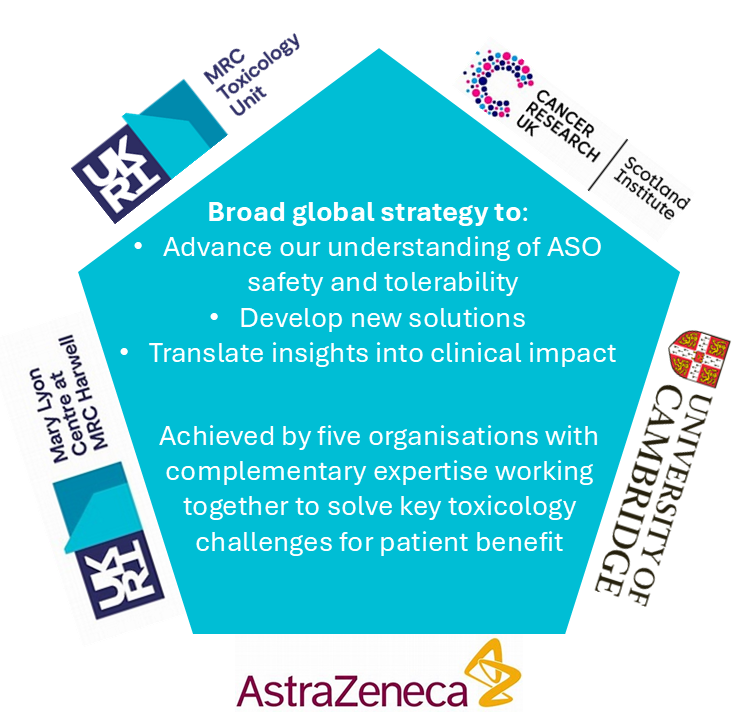
The MRC Toxicology Unit and Department of Biochemistry at the University of Cambridge, AstraZeneca, Cancer Research UK Scotland Institute, and the Mary Lyon Centre at MRC Harwell have been awarded a £3.4 million MRC Prosperity Partnership grant to fund research into understanding the early safety profile of antisense oligonucleotide (ASO) therapeutics. Prosperity Partnerships are funded by UKRI-MRC to support long-term collaborations between academic and industrial partners working at the forefront of emerging therapeutic technologies.
ASO-based medicines are one of the most promising types of nucleic-acid therapy for rare and inherited diseases. Their designable nature allows each treatment to target a specific disease-causing RNA molecule in the cell, opening treatment possibilities for currently undruggable diseases. As investment and research into ASO development grow, there is a renewed need for high-quality laboratory models able to clarify how these molecules behave in human cells and tissues, and how ASO design and interactions with other cellular components contribute to safety.
Using the expertise of multiple institutes and research groups, the Prosperity Partnership will address this challenge by generating new human-relevant in vitro models to study the human specific biological pathways through which ASOs exert both their therapeutic and unintended effects. These models will give researchers an earlier, more accurate readout of how different ASO designs interact with human tissues, helping guide the development of safer next-generation ASO therapeutics. The collaboration draws on expertise across RNA biology, toxic mechanisms, model development and translational research, forming a strong foundation for future innovation.
This initiative marks a significant advance in safety science and highlights the broader challenges facing next-generation nucleic-acid medicines. Additional platforms capable of integrating mechanistic studies, whole-organ physiology and clinical translation; will be required to fully address the safety needs of nucleic acid therapies including mRNA, RNA-interference and gene-editing technologies. The Prosperity Partnership therefore forms a critical building block in a wider national effort to ensure that the UK can safely realise the full potential of these promising therapeutics across disease areas.
Professor Anne Willis, Director of the MRC Toxicology Unit and academic lead on the partnership, explains the importance of this initiative: “A deeper understanding of how ASO’s interact with our cells and tissues will help us predict if side effects will occur. This work will complement our recent funded INTREPID Programme to develop human tumour explant models and support alternatives to in-vivo testing.”
Dr Stefan Platz, SVP Clinical Pharmacology & Safety Sciences, AstraZeneca R&D, said:
“This partnership brings together exceptional expertise in science, technology and data to address numerous challenges in therapy development. Together, we aim to set new standards in safety and innovation, driving meaningful progress for patients facing some of the most complex medical conditions.”
Dr Sara Wells, Director of the Mary Lyon Centre at MRC Harwell, said:
“The use of multiple datasets, model systems and advanced analysis modalities is a key element of this exciting project, which couples the multidisciplinary team efforts to minimise the use of animals and wasteful repetition of experiments with the increased translatability of more predictive models and novel approaches to the design and testing of therapeutics. We are delighted to be part of this academia-industry partnership aimed at improving patient health.”
Professor Owen Sansom, Director of the CRUK Scotland Institute, said:
“We are incredibly excited to be part of this groundbreaking MRC-funded initiative, providing our extensive expertise in the use of models to gain mechanistic insight on biological processes and adverse outcome pathways. Our aim is to make evidence-based predictions in the use of new therapies to improve the likelihood of success for patients.”
Professor Eric Miska, Head of the Department of Biochemistry, University of Cambridge, said: “I am incredibly excited to support this ground-breaking collaboration by connecting our fundamental research to industry and the clinic”.
Dr Glenn Wells, MRC Deputy Executive Chair, said:
“This project is part of a £9 million public sector investment through MRC’s first Prosperity Partnerships. With additional contribution from industry and close collaboration with key regulatory bodies, we are addressing the safety and toxicity of advanced therapies. This research is critical to improving how gene, cell-based, and nucleic acid-dependent therapies are developed for conditions such as cancers and rare genetic disorders, so we can make meaningful improvements to patient outcomes.”
The new laboratory models created through the Prosperity Partnership will support the growing sector by enabling earlier, more reliable assessment of safety. These systems will help researchers refine design long before therapies reach costly animal studies or clinical testing. The partnership will also train early-career researchers and strengthen national expertise in RNA-based therapeutics.more effective treatments, improving outcomes for patients.